
The challenge
During the pandemic, this well-known kitchen and homeware retailer watched its third-party marketplace sales boom, as everyone shopped from home. On paper it looked great. In practice it came with two problems. Every marketplace sale gave away around 20% in commission, and it gave away the customer too: no email address, no relationship, no second sale.
They came to us to change that. Grow their own direct online sales, pay less away in commission, and build an online store that finally reflected how well their physical shops were already doing.
What we did
We had run digital reviews for them before, so we knew the business. This time the brief was direct sales, and we went at it on three fronts:
- Google Ads to drive high-intent traffic straight to their own store, launched ahead of the Christmas peak.
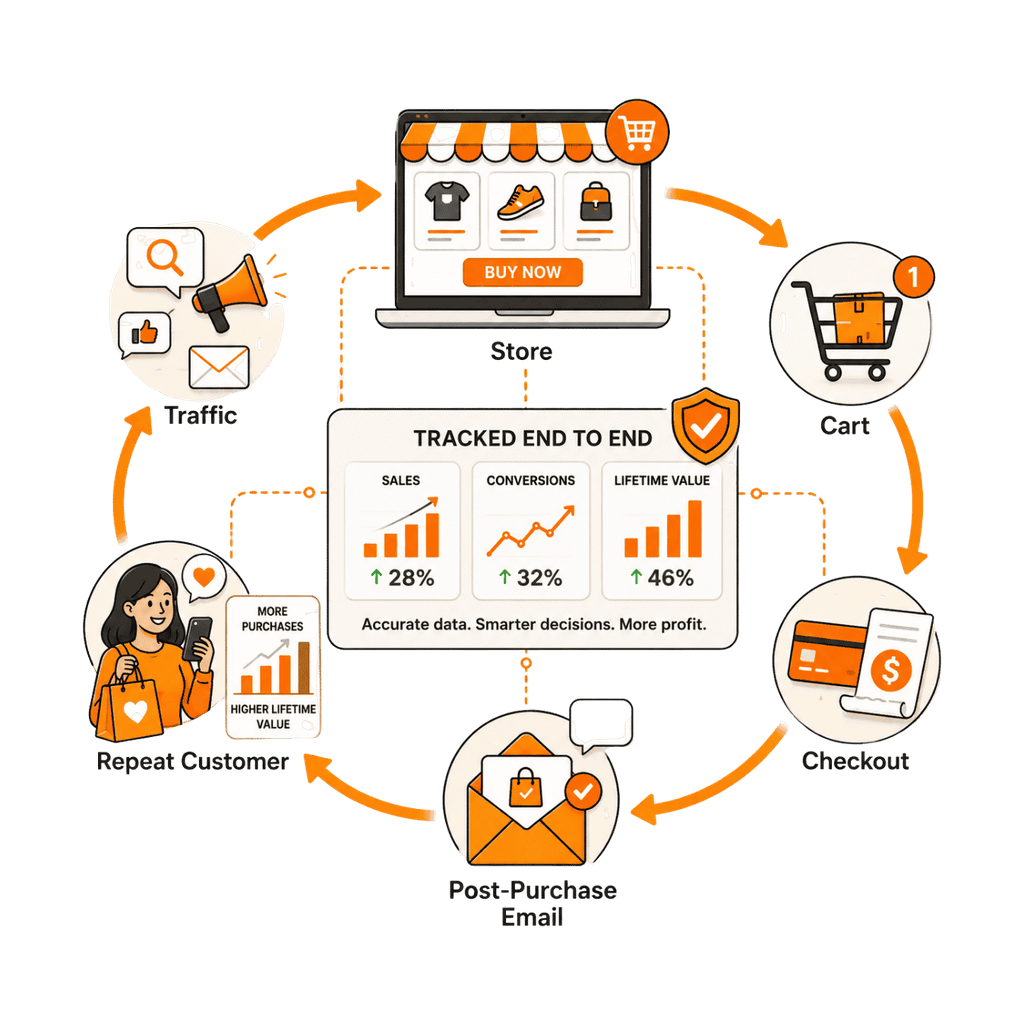
- Analytics and tracking, set up properly first, so we could see the split between direct and marketplace sales clearly and prove the shift rather than assume it.
- Email marketing. They already had a welcome series, but it only picked up the odd sale. We rebuilt it into a proper story, and added an abandoned-cart flow, to capture the new traffic and turn first-time buyers into repeat customers, the one thing a marketplace sale never lets you do.
The results
The mix flipped, which was the entire point.
In our first four months, over the Christmas peak, direct sales rose 606% while marketplace sales fell 66%, and Google Ads returned 4.6 times its spend. Across the full year that followed, direct online store sales were up 122% to a record, marketplace sales fell by two-thirds, and the store paid around $40,000 less in commission than the year before.
The email work pulled its weight too, and it is a good example of how we multiply one channel with another. They already had a welcome series, quietly picking up the odd sale. We rewrote it into a story, and it brought in $137,000 in eight months, squeezing far more revenue out of the very same traffic the ads were paying to bring in.
Best of all, a direct order is now worth around double a marketplace order, and unlike a marketplace sale, it comes with a customer they can talk to again. They swapped rented sales for a store of their own, with the margin and the relationship to match their shops.
And these numbers are only the start. The 4.6x return and the growth above are the first layer. With email marketing now in play, the real compounding comes from repeat custom and the revenue that builds on top of every first sale. It also gives us a growing pool of customer data to work from, so we can test lookalike audiences and get in front of more people who look exactly like the ones already buying.